Assist.
Check a document.
Prepare a decision.
 VizuaraJoin the next cohort ↗
AI Agents for Enterprises
Learn to connect AI to your company’s documents, tools, and business processes. Start with guided workflows, test realistic problems, and build a pilot your team can evaluate. No prior coding required.
 Led by Dr. Rajat DandekarCo-founder, Vizuara · PhD, Purdue University
From supplier onboarding to purchase requests, the shift is already underway.
See what’s changing ↓Agents connect the steps.
People set the direction.
Check a document.
Prepare a decision.
Connect teams and tools.
Keep approvals in the loop.
Let tested workflows run.
Bring exceptions to people.
Changing skills. WEF’s 2025 survey found employers expected 39% of core skills to change by 2030, across multiple economic trends. Read the report ↗
Value still matters. Gartner forecast that over 40% of agentic AI projects would be canceled by the end of 2027. This is a prediction, not an observed failure rate. Read the forecast ↗
Make a request. Review the evidence. Approve the change. Try the workflow below.
Work through a conversation. The ERP still enforces business rules and keeps the records.
Guided simulation with synthetic records. No live AI, ERP connection, document upload, or external transaction.
Policies guide the plan. Current supplier status and budget come from the ERP.
Create a supplier and a purchase request. PO release and payment activation remain separate approvals.
Check the receipt after a lost response. Recover the existing record instead of creating another.
Salesforce describes agents guiding supplier applications, checking documentation, and coordinating approvals. Our walkthrough explores that business pattern in an independent, vendor-neutral teaching example. It is not a reproduction of the Dreamforce demo or a live enterprise integration.
Explore Salesforce’s supplier-onboarding use case ↗Adjust the assumptions. This estimates the value of staff time released, not cash savings or guaranteed ROI.
Five familiar businesses. Five concrete workflows you can learn from.

Independent industry examples, not Vizuara client claims. Deployment, pilot, and announcement status follow the linked sources.
A focused toolkit for decisions, knowledge, and reliable execution.
 TypeSafe AI DECISION MODEL · EARLY ACCESS
Classify, extract, and route with typed outputs and confidence estimates.
Compare routing accuracy against an LLM baseline. Valid types still need correct decisions.
Turn source documents into linked Markdown pages. Retrieve policy context through an index and file search—a vectorless option at modest scale.
Test citations, freshness, and permissions against hybrid RAG. Keep live ERP state in the ERP.
Read the original LLM Wiki approach ↗An approach, not a branded framework. The document symbol above is illustrative.
Model the workflow as state and transitions. Pause for a human decision and resume with a checkpoint.

Expose tools through a common protocol. Keep authorization and business rules enforced by the service.
 Temporal
Carry a business workflow through outages, retries, and approvals that arrive hours or days later.
Start with guided n8n workflows. Explore LangGraph, compare Wiki retrieval and Jev, and use Temporal for a recovery exercise.
Logos identify the technologies discussed; no partnership or endorsement is implied. Links go to original documentation. Tool coverage may evolve before the cohort begins.
Eight practical sessions. Start with the foundations, then build with the tools behind modern enterprise agents.
Configure workflows, connect sample data, and test business outcomes.
Extend tools, orchestration, and deployment in the starter repository.
All backgrounds welcome. Use guided n8n workflows and starter notebooks. Experienced developers can take the optional Python extensions. Plan for 3–5 hours of practice each week; provider API charges may be separate.
Choose a workflow from your own industry. Connect knowledge and tools, add human approvals, and show that the result works using synthetic or approved data.
Build your agent with us ↗# What “ready for review” means
deliverables = {
"agent": "runnable service + API",
"evidence": "citations + scoped retrieval",
"controls": "approval + audit trail",
"evaluation": "golden set + failure tests",
"operations": "cost, latency + runbook",
"handoff": "demo + architecture memo"
}Supplier onboarding and purchase requests.
Invoice exceptions and reconciliation review.
Employee onboarding, leave, and policy queries.
Account research and proposal preparation.
Booking queries and refund-case coordination.
Product discovery and order support.
Appointment coordination and document routing.
Contract review support and evidence collection.
Co-founder, Vizuara
PhD, Purdue University · B.Tech & M.Tech, IIT Madras
Rajat teaches reinforcement learning, AI agents, and reasoning models. His work at Vizuara connects the underlying ideas with the practical decisions involved in building and evaluating AI systems.
In this bootcamp, you’ll work through the design of an enterprise agent, implement its tools and controls, and test whether it does the job you intended.
Meet the Vizuara teaching team ↗Our co-founders teach across Vizuara’s AI programs. Rajat leads this bootcamp; any additional teaching sessions will be listed in the final schedule.
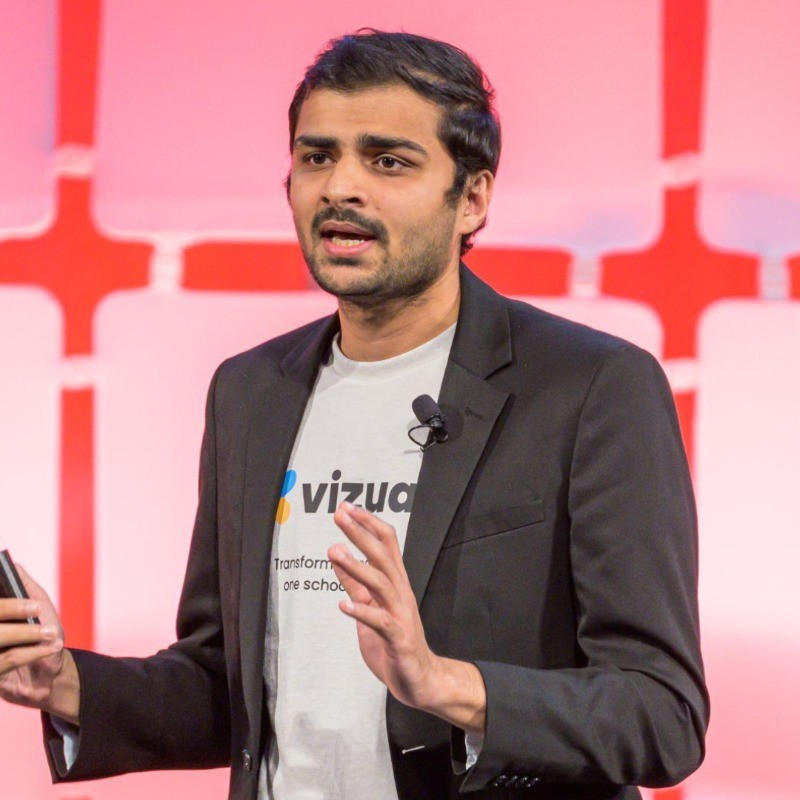
Co-founder · PhD, MIT
LLMs, agents, and retrieval

Co-founder · PhD, MIT
Computer vision and scientific ML
students learning with Vizuara
Vizuara course library ↗Vizuara’s published figure across its course library; not a completion count or enrollment in this new bootcamp.Give engineers, product owners, and technical leaders a shared foundation—and a working system.
For professionals, founders, students, and domain experts—with or without a coding background.
Bring a group into the cohort. Discuss your team size, business workflow, procurement needs, and data constraints before enrollment.
Dedicated private cohorts, custom integrations, and private-data deployment are scoped separately and subject to availability.
The prices below already include the early-bird discount, valid through 10 October 2026.
OR CHOOSE A BUNDLE
Yes. Everyone can participate, including people who are not comfortable coding. We begin with LLM basics and use guided workflows, visual tools, and starter templates. You’ll learn to design, build, and evaluate an agent. Optional Python extensions give experienced developers more depth.
You’ll build a workflow that retrieves evidence, uses tools, and asks for approval before taking action. Guided templates make it accessible without starting from a blank code editor.
Yes. Teams with more than 25 participants (26 or more) receive a 7% corporate discount. Use the team inquiry for a quote and invoicing. Private cohorts and custom delivery are scoped separately.
Labs use synthetic or approved data. Do not bring confidential data without your organization’s permission and an approved environment. The curriculum covers access boundaries and data handling, but enrollment does not include a private deployment environment.
The bootcamp starts Saturday, 31 October 2026. All eight lectures run on Saturdays and Sundays, 7:00–9:00 AM IST, through 22 November. The displayed prices already include the early-bird discount, valid through 10 October 2026. Choose your course or bundle in the fees section, then select Enroll now to continue on Vizuara.
The goal is a working, measurable pilot and a clear handoff. Your organization must still complete its security, compliance, load, and integration reviews before production use.